Note: This guide is intended to help you understand the differences between sworn and certified translations. However, every visa application is unique. This post does not constitute legal advice. Always verify the specific translation requirements for your destination country with official government sources or a legal professional.
In the high-stakes world of 2026 immigration, your professional credentials and financial stability depend on the documents that prove them. We are seeing more cases of „invisible rejection,” where applicants are highly qualified but are denied because their supporting documents are not „legally legible” to a caseworker. As of early 2026, the situation has changed significantly. The UK has raised its language requirements for Skilled Workers to a B2 level. The EU has fully implemented the Entry/Exit System (EES) and eIDAS 2.0 digital authentication standards. As a result, the margin for error has disappeared. In this environment, using the wrong type of translation has become a major reason for mandatory visa refusal.
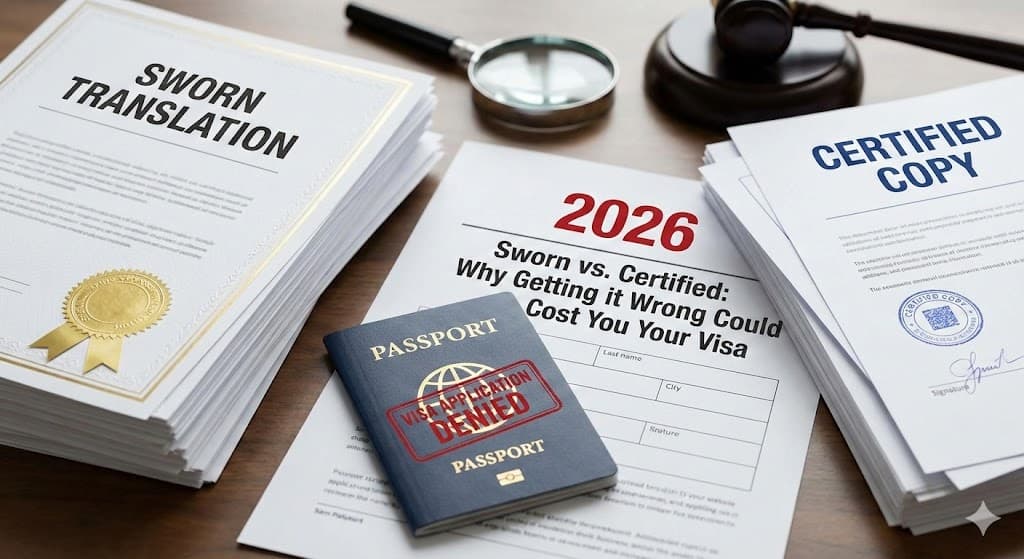
It is crucial to understand the difference between „Certified” and „Sworn” translations to navigate these new challenges. In Common Law countries like the UK, USA, and Australia, Certified Translation remains the standard. This requires a professional translator or agency to provide a „Certificate of Accuracy” that includes their credentials, a signature, and the date. However, the 2026 guidelines from UKVI state that these must be submitted as a single, high-resolution PDF that combines the original and the translation. This allows for new independent verification protocols where AI-powered scanning systems can quickly cross-check the two documents.
On the other hand, Sworn Translation is the standard in Civil Law countries like France, Spain, Germany, and the UAE. These are done by Sworn Translators, who are officially appointed by a government ministry or court. Unlike standard certifications, a sworn translation includes a legal oath of accuracy and often comes with a physical stamp or a Qualified Electronic Signature (QES) to comply with the EU’s eIDAS 2.0 framework. If you submit a UK-style certified translation to a Spanish or Italian consulate, it will likely be considered legally invalid, delaying your application indefinitely.
The consequences of making a wrong choice in 2026 are serious. The UK Home Office has increasingly moved toward mandatory refusals for applications that do not meet the exact translation checklist. If a translator’s registration number or contact details are missing, caseworkers are now instructed to deny the application without a request for further information to save processing time. Additionally, the use of raw AI-generated translations is under close scrutiny. In 2026, submitting a machine-translated document that lacks certification from a human professional is often flagged as „deception,” which can result in a severe 10-year ban on future travel.
Several specific 2026 regulations make precision even more important. As of January 8, 2026, many UK work visa routes require proof of B2-level English. If you are using a degree from a foreign university to meet this requirement, the translation must clearly show that the medium of instruction was English. Furthermore, the EU Entry/Exit Scheme (EES), fully operational as of April 10, 2026, now links your biometric data directly to your digital records. Any discrepancy in a translated name or date of birth can trigger an immediate security flag at the border. As the world moves toward full eVisas by late 2026, a single poor translation can prevent your digital status from being created.
To ensure your application is successful, always follow a strict 2026 checklist. First, verify the requirements of the receiving body: is it for the Home Office (Certified) or a European Consulate (Sworn)? Second, make sure the translation includes the „Statement of Truth,” the date, and the translator’s complete professional credentials. Third, ensure the file is digital-ready—high-resolution and machine-readable for modern AI-assisted scanning. Finally, confirm a process where a qualified professional accepts legal responsibility for the text.
In 2026’s increasingly automated immigration systems, accuracy equals speed. A perfect translation allows for straight-through processing, which is the fastest route to approval. When in doubt, it is often safer to choose the higher standard. While a sworn translation is usually accepted where a certified one is requested, the opposite is rarely true. Investing in a legally compliant translation is no longer just a formality; it is essential for your global mobility.